
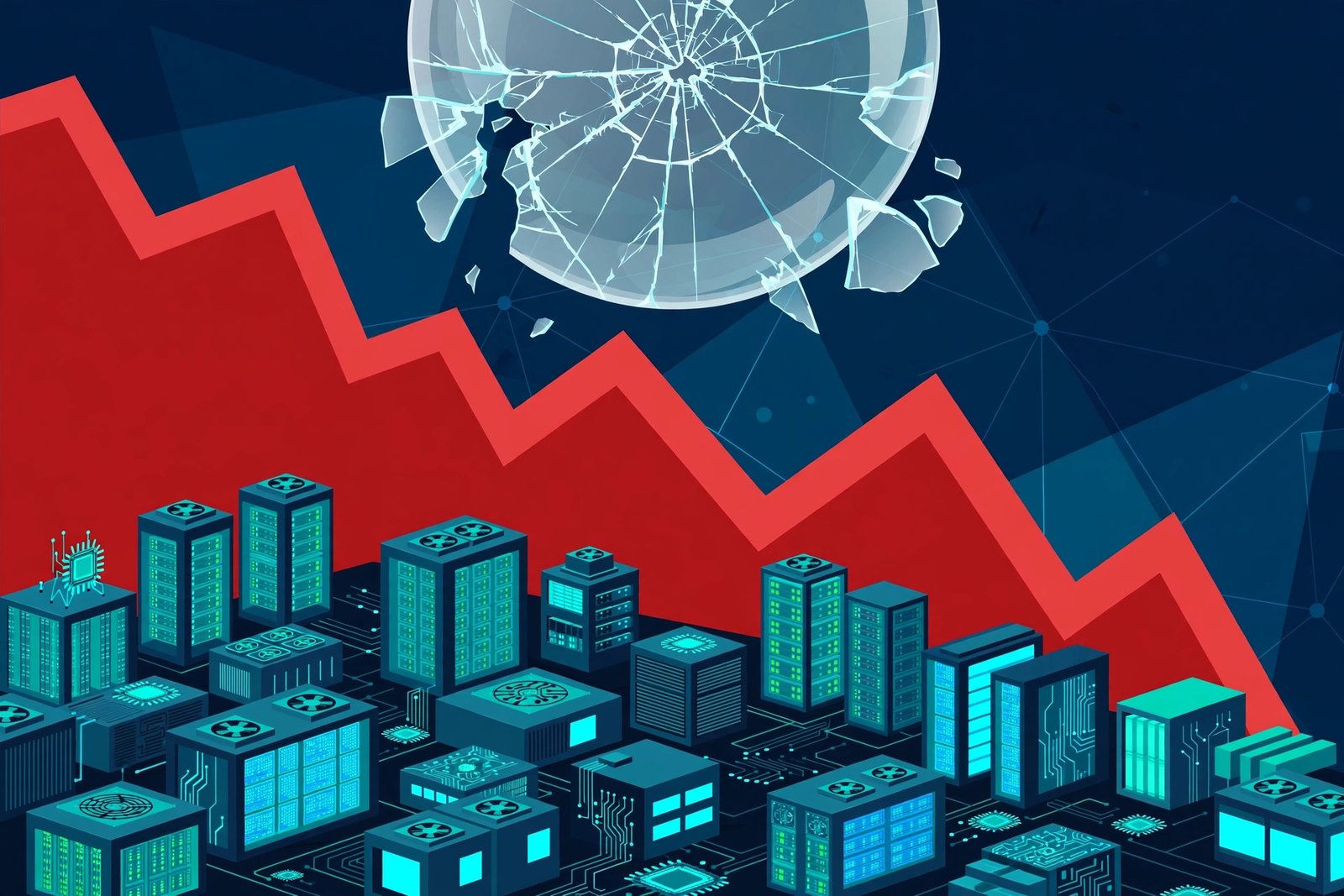
I woke up on Friday morning to a phone full of red numbers, and for a second I thought something had broken.
Google’s parent company, Alphabet, had lost 12.6% on Wall Street the day before. That one drop wiped out roughly $500 billion in market value — more than the entire economy of most countries, gone in a single trading session. Intel fell 23% after hours. Amazon dropped 7%. Chip stocks across Asia followed them down on Friday morning, with Japan’s Nikkei sliding 3% at one point.
And the strange part? Alphabet had just reported a quarter most companies would kill for.
Revenue rose 25% to $127.6 billion. Operating income climbed 30% to $40.6 billion. Its cloud business did well. Search kept growing, just more slowly than before. Net income fell about 25% to $26.2 billion, but a big chunk of that was an $8.2 billion paper loss on its SpaceX stake — the kind of accounting swing that says very little about how the actual business performed that quarter.
So why did investors run for the exits?
Because this sell-off was never really about one quarter. It was about a question that has been hanging over the whole AI boom for months, and this week it finally got loud: how much money are these companies burning to build AI, and when — if ever — does it start paying for itself?
I’ve been writing about AI tools for over a year now, and I use them every single day for this blog. I’m not an AI sceptic. I think the technology is real, and I think it will change how a lot of us work. But I also think we’ve reached the point where honest reporting has to separate two different things: AI as a useful tool, and AI as a stock market story. This week, those two stories pulled hard in opposite directions.
What actually happened this week
Let’s get the timeline straight, because the headlines blurred together fast.
On October 28, Alphabet reported its third-quarter results. Revenue up 25%, operating income up 30%, cloud strong, search growth slowing. The market read it as a company spending so much on AI infrastructure that its cash flow turned negative, and the stock fell 12.6%.
Late the same week, Intel and Amazon reported too, and both gave investors more reasons to worry about costs. Intel’s outlook disappointed and its shares plunged 23% after hours. Amazon fell 7% as its own AI infrastructure spending raised the same question: how long can this burn rate go on?
By Friday morning in Asia, the mood had spread. Japan’s Nikkei dropped as much as 3%, led by chip equipment makers Advantest, down 9.1%, and Tokyo Electron, down 5.6%. South Korea’s KOSPI slumped 5% for the month. Bonds rallied as investors looked for somewhere safer to hide. Even the Federal Reserve’s decision to hold interest rates steady on Wednesday fed into the same nervous mood — money isn’t getting cheaper, and AI data centres are not getting cheaper to build either.
None of this means AI stopped working on Thursday. ChatGPT still answered questions. Gemini still wrote code. Your favourite AI image tool still made pictures. What changed was the price investors were willing to pay for the promise of future AI profits, and that price fell sharply.
That’s an important distinction, and it’s one a lot of coverage skipped. A stock falling is not the same thing as a technology failing. But a stock falling this hard, across this many companies at once, is a signal worth paying attention to. It tells you the market’s patience is wearing thin.
The $300 billion question nobody can dodge
Here’s the number that keeps coming back to me: Alphabet’s reported 2027 capital spending target is above $300 billion.
Read that again. Three hundred billion dollars. In one year. Mostly on data centres, chips, and power infrastructure for AI.
Google isn’t alone. Microsoft, Amazon, Meta, and OpenAI’s partners are all spending at a scale that would have sounded absurd five years ago. OpenAI’s CEO Sam Altman reaffirmed a target this week to cut the five-year cost of building a gigawatt of AI capacity to $20 billion, down from a $70 billion estimate. Even if you take that target at face value — and targets from CEOs are not results — it tells you how expensive the current path is. A single gigawatt of AI capacity costs tens of billions of dollars to build and run.
Now ask the obvious question: where does that money come back from?
For Google, part of the answer is already uncomfortable. Reports this week noted that Google itself has admitted each AI Mode query earns less than a comparable traditional web search. The company’s stated fix, at least in the US, is more ads inside AI answers rather than a pricier product. Think about what that means for a second. The most dominant search company on earth is still converting AI usage into ad revenue at a discount, and its plan is to show you more ads inside the answers themselves.
Cloud is the other half of the story, and it’s a brighter one. Alphabet’s cloud business beat expectations. Companies are genuinely renting AI computing power, and that revenue is real. But cloud growth, even strong cloud growth, has to cover data centre bills that are growing even faster. When spending outruns revenue growth for long enough, investors stop giving you the benefit of the doubt. This week, they stopped.
I don’t think that makes Google a bad company, or AI a bad bet. I think it makes the current pace of spending a real risk, and I think pretending otherwise would be dishonest. Every boom has a moment where someone asks to see the receipts. This week, the market asked.
Wait — isn’t this just a normal market wobble?
Fair question, and I’ve asked it myself. Markets fall all the time. Tech stocks are volatile. A 12% drop, even a huge one, doesn’t automatically mean a bubble is bursting.
Here’s why I’m not dismissing this one as noise.
First, the scale. A $500 billion single-day loss in market value for one company is not routine, even by tech standards. It was driven not by a scandal or a product failure, but by a business model question: spending is rising faster than the cash coming back.
Second, the breadth. This wasn’t just Alphabet. Intel, Amazon, AMD, Nvidia, Marvell, and chip equipment makers across Asia all fell together. When a whole sector moves at once, it’s usually about a shared story, not a single company’s mistake. The shared story here is AI infrastructure costs.
Third, the timing. This sell-off landed right after a string of strong earnings reports, not weak ones. Alphabet grew 25%. That’s the kind of result that normally sends a stock up. When good results still trigger a sell-off, the market is telling you it has moved on from “is this company growing?” to “is this growth worth what it costs?” That’s a harder question, and it’s one investors will keep asking.
That said, I want to be careful not to overclaim. One bad week does not prove a bubble, and it certainly doesn’t prove AI is finished. The dot-com crash took years to play out, and plenty of people called it far too early. Markets also bounce back — sometimes fast, sometimes for reasons that have nothing to do with fundamentals. If you read anyone this week who tells you they know exactly what happens next, don’t believe them. I don’t know, and neither do they.
What I can say is this: the easy phase, where every AI announcement sent stocks up and nobody asked about costs, looks over. The next phase will be slower, pickier, and more honest about prices. For regular users, that might actually be good news.
The other story this week everyone missed
While the stock market panicked, something genuinely interesting happened on the technology side — and it barely made the front pages.
On October 29, Mistral, the French AI company, released the open weights for Mistral Large 4, nicknamed “Le Chonk”: a 1 trillion parameter, natively multimodal flagship model. The weights went up on Hugging Face, with a quantized version available for self-hosting. Mistral claims strong results, including 19.7% on FrontierCode 2.0 — which it says is the top open-weight score — plus 48% on a coding agent benchmark and 41% on Terminal-Bench 4.0.
Now, I have to be straight with you: those are Mistral’s own numbers, and independent testing will take time. I haven’t run this model myself, and I wouldn’t trust any reviewer who claims to have fully tested a 1 trillion parameter model in 24 hours. But the direction matters more than any single benchmark.
Open-weight models like this are the counterweight to the spending panic. If a powerful model can be downloaded and run by others, the cost of using AI doesn’t have to flow only through a handful of giant cloud providers. Smaller companies, universities, and developers in countries like Pakistan and India get a shot at building on top of serious AI without paying whatever price a big provider sets. That’s not a small thing.
It also fits a pattern I’ve noticed all year. The most useful AI progress for ordinary people hasn’t always come from the biggest, most expensive models. It has come from models getting cheaper, smaller, and easier to run — and from tools that solve one specific job well. If the giant spending spree slows down, that trend doesn’t stop. It might even speed up, because efficiency suddenly becomes a selling point instead of an afterthought.
LG gave us another glimpse of the longer game this week too. On its October 28 earnings call, the company said it plans to enter the home humanoid robot market by 2030. That’s four years away, and home robots have been “four years away” for a long time. I’m not holding my breath. But it shows where some of this AI investment is aimed: not just chatbots, but machines that move around your house. Whether that pays off is a question for 2030, not for this week’s stock charts.
What this means if you live in Pakistan or India
Most of the coverage of this crash was written for Wall Street. Let me translate it for readers in Quetta, Karachi, Lahore, Delhi, or Mumbai, because the effects here are different — and in some ways more practical.
First, don’t panic about your AI tools disappearing. Google, Microsoft, and OpenAI are not going bust because their stocks fell. They have enormous cash reserves and real revenue. Your ChatGPT, Gemini, or Claude subscription is not about to vanish overnight. If anything, competition between these companies is fiercer than ever, and that usually keeps prices in check for users. For a closer look at AI in India, see our guide to Jio AI in India.
Second, watch prices, not headlines. The real question for us is whether AI subscriptions, API costs, and cloud prices go up, down, or stay flat over the next year. If big companies need to show profits sooner, one obvious lever is raising prices or trimming free tiers. We’ve already seen free plans get tighter across several tools this year. If you rely on a free tier for work or study, have a backup tool in mind. I keep two or three options for every job I do regularly, precisely so one price change doesn’t strand me.
Third, this is a bad week to make money decisions based on fear — in either direction. I’m not a financial adviser, and this article is not investment advice. But I can share a plain observation: people who buy or sell stocks because of one dramatic headline usually regret it. The same goes for people who start or quit a freelancing career because of one week’s tech news. AI demand from real clients — businesses that need content, code, designs, marketing help — does not rise and fall with a single day’s stock chart. It moves much more slowly, and it’s still there.
Fourth, there is an opportunity hiding in the efficiency story. If the industry shifts from “bigger at any cost” to “cheaper and more efficient,” that favours developers and creators outside the US. Open-weight models, cheaper APIs, and tools that run on modest hardware matter far more in Pakistan, where a high-end GPU can cost several months’ salary and where mobile data and electricity costs are real constraints, than they do in Silicon Valley. A 1 trillion parameter model you can’t run is less useful to you than a small, fast model you can actually afford to use. Keep an eye on that trade-off, not just on which model tops a benchmark chart.
And one more thing, specific to our region: be careful with the “AI bubble” content farm that will follow this news. In the next few days, you’ll see dozens of videos and posts promising to explain the crash, usually with a thumbnail of a terrified man pointing at a red chart. Many of them will be recycled, exaggerated, or just wrong. Check the date on any article you read, check whether it names its sources, and be suspicious of anyone selling you a course on “how to profit from the AI crash” within 48 hours of it happening. Nobody has a proven playbook for that yet.
A quick reality check on the numbers
Because this story is full of big numbers, it’s worth lining them up in one place so you can see what is solid, what is claimed, and what is still just a target.
| Claim | What we actually know | How much to trust it |
|---|---|---|
| Alphabet revenue, Q3 | $127.6 billion, up 25% year on year | Reported results — solid |
| Alphabet operating income, Q3 | $40.6 billion, up 30% | Reported results — solid |
| Alphabet net income fall | Down about 25% to $26.2 billion, hit by an $8.2 billion paper loss on SpaceX | Reported, but the SpaceX part is a valuation swing, not cash lost running the business |
| Alphabet stock drop | Down 12.6%, wiping about $500 billion in market value | Market data — solid, and unusually large |
| Intel after-hours drop | Down 23% after a disappointing outlook | Market data — solid |
| Amazon drop | Down 7% as AI spending worried investors | Market data — solid |
| Alphabet 2027 spending target | Above $300 billion in capital spending | A target, not a result — plans change |
| OpenAI’s gigawatt cost target | $20 billion over five years, down from a $70 billion estimate | A CEO target reaffirmed this week — not a delivered result |
| Mistral Large 4 benchmarks | 19.7% on FrontierCode 2.0, 48% on a coding agent index, 41% on Terminal-Bench 4.0 | Mistral’s own claims — wait for independent tests |
| LG home humanoids | Entry planned by 2030 | A company plan announced on an earnings call — a long way from a product |
I put that table together because I wish more tech coverage did this. Big numbers sound convincing on their own. They get a lot less scary — and a lot more useful — when you separate ‘this happened’ from ‘someone hopes this happens.’

So is the bubble bursting, or not?
If you want a one-word answer, I don’t have one, and I don’t trust anyone who pretends they do. Here’s the honest version, as I see it after a week of reading earnings reports, market coverage, and the actual model announcements underneath the noise.
The case for “yes, something is popping” is real. Spending has reached a level where even record revenue doesn’t satisfy investors. AI search earns less per query than old search. Free tiers are tightening. Companies are promising hundreds of billions in future spending while the returns are still fuzzy. Those are classic late-boom warning signs, and ignoring them would be foolish.
The case for “no, this is a correction, not a collapse” is also real. The technology keeps improving. Cloud revenue is genuinely growing. Open models are getting stronger. Businesses are actually using AI for real work — not just talking about it. And unlike the dot-com era, today’s biggest AI spenders are profitable companies with real products, not startups with a website and a dream. A correction hurts. It doesn’t necessarily kill the underlying trend.
My own read sits in the middle, and it’s the least exciting option, which is usually a good sign it’s honest. I think we’re moving from the “AI can do anything and costs don’t matter” phase into the “prove it, and prove it profitably” phase. Some companies will pass that test. Some projects will get cancelled. Some prices will rise. Some tools will get better and cheaper because efficiency finally matters. That messy middle is where most technology stories actually live, long after the hype headlines fade.
If you’re a student, a freelancer, or a small business owner reading this in Pakistan or India, that middle phase is actually where you want to be. You don’t need the biggest model. You need a reliable tool, at a price you can afford, that does your specific job well. The market panic doesn’t change that job. It just means you should pick tools more carefully, keep backups, and not build your whole income on one free tier or one company’s promises.
So, what would I actually do?
I get asked for a bottom line a lot, so here is mine, plainly.
I would not stop using AI tools because of this crash, and I would not rush to pay for expensive new ones because of it either. I’d stick with the tools that already earn their keep in my daily work — for me right now, that means a mix of ChatGPT, Gemini, and Claude depending on the task, which is why I compared them properly in my earlier guide — and I’d keep a free or cheap backup for each one. I’d watch subscription prices over the next few months, because that’s where a spending squeeze will show up first for ordinary users, long before it shows up in a stock chart.
I would not make any investment decision based on this article or this week’s headlines. If you own tech stocks, talk to someone qualified before you act, and be wary of anyone on social media telling you to buy the dip or sell everything. Both messages get a lot of engagement this week. Neither is advice.
And I would pay more attention to the quiet stories than the loud ones. Mistral opening up a trillion-parameter model matters more to the long-term price of AI than one day’s stock move. Cheaper, more efficient models matter more to a freelancer in Lahore than a $300 billion data centre plan in the US. The loud story tells you what scared investors today. The quiet story tells you what you’ll actually be able to use next year.
That’s where I’ll be looking. And if the market bounces back next week — which it very well might — I’ll say so, and I’ll say what changed. I’m not here to call a crash and then quietly forget about it. I’m here to keep track, week by week, of whether AI is getting more useful and more affordable for people like us. This week, the honest answer is: the tools are still useful, the prices are still uncertain, and the companies building them are under more pressure than they’ve been in a long time.
That pressure isn’t the end of AI. But it is the end of the free pass. And honestly? That might be healthy.
Sources: Reuters market coverage of the October 30 sell-off and Alphabet’s earnings; Mistral’s October 29 open-weights announcement as summarised in the October 30 AI daily digest. Figures for Alphabet’s quarter are as reported by the company.