
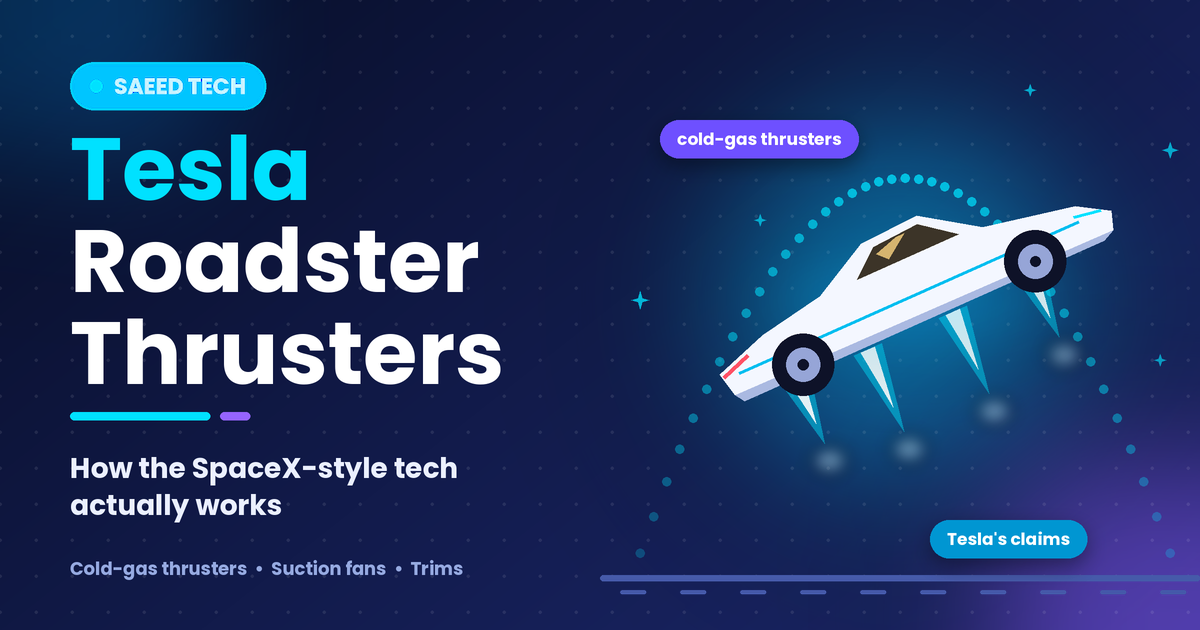
Most car launches are about lap times. Tesla’s Roadster event was about a car leaving the ground. It jumped, twisted in the air, and landed softly, and within hours the clips were everywhere. I watched the footage twice. The first time, I watched the stunt. The second time, I watched the hardware, because under the show there is a serious engineering question: how does a road car borrow rocket technology to do that, and how much of it could a buyer ever use?
This page explains the technology in plain English, separates what Tesla has demonstrated from what it has merely claimed, and keeps track of what is still unknown. One point deserves to be stated at the start. Tesla has announced no price and no final specifications, so every performance figure below is a Tesla claim rather than a tested result. I will update this page as that changes.
Last updated: October 17, 2026.
What Tesla actually showed
Tesla presented the next-generation Roadster in mid-October 2026, and the demonstration was built around the thruster system. The car launched off a ramp, cleared five other Teslas parked in a row, rotated in the air, and landed under control. Coverage from Electrek and NBC News described the same sequence, and Tesla’s own Roadster page was updated alongside the event.
The demonstrations were short, and that matters. Nothing in the footage showed sustained flight, long thrust, or repeated jumps one after another. What Tesla proved is that the system works in controlled bursts. What it has not yet proved is how the system behaves in ordinary ownership: repeated use, refilling, servicing, and life on public roads.
It is also worth separating the three versions of the car, because the headlines treat them as one. Only the upper trims carry thrusters at all, and the most extreme version is not approved for public roads, according to Tesla’s own page. The details of each trim are in the table further down.
The short version
The Roadster uses cold-gas thrusters, not rocket engines. They release compressed gas through nozzles to create force in short, precise bursts.
Tesla says the system was developed with SpaceX and required new hardware and new controls to work in the atmosphere instead of in a vacuum.
Only the top trims have the thrusters. Tesla’s own page says the Rocket version is not approved for public roads.
There is still no price for any version, and the only production date Tesla has given is 2028.
What is a cold-gas thruster?
Forget fire and explosions for a moment. A cold-gas thruster is a pressure tank, a valve, and a nozzle. Open the valve, and the stored gas rushes out in one direction. The thruster, and whatever it is attached to, gets pushed in the opposite direction. It is the same physics as letting go of an inflated balloon and watching it dart across the room.
‘Cold’ means there is no combustion. Nothing burns. That makes the system simple, reliable, and very precise, which is why spacecraft have used cold-gas thrusters for decades to make small orientation changes in orbit. A satellite does not need enormous power to rotate a few degrees. It needs small, exact pushes, delivered on command, and cold gas does that well.
The weakness is energy. Burning fuel releases far more energy than simply releasing stored gas, so a cold-gas system runs out of useful push quickly. Spacecraft accept that trade because their adjustments are tiny. A car attempting jumps and hard acceleration is asking much more of the same basic system, and the gas supply becomes the limiting factor. That single fact explains the shape of the whole demonstration: short hops and flips, not flight.
There is a second difference between a spacecraft and a car. In a vacuum, expelled gas behaves predictably and nothing pushes back. In the atmosphere, the thruster works against air pressure, weather, and a vehicle that is also interacting with the road through its tyres. Tesla says the Roadster system needed new hardware and controls for exactly this reason, and that is a credible claim. Moving a proven space technology into a car is not a copy-and-paste job.
The part nobody talks about: storing the gas
The thrusters are only as good as their gas supply, and the supply is the hardest packaging problem in the car. Tesla says it packed carbon-fibre-wrapped pressure tanks into every spare space in the Roadster, and that more gas means more airtime.
That detail deserves more attention than it received at the launch. Pressure vessels of this type, often called composite overwrapped pressure vessels, are standard equipment in aerospace. A lightweight liner is wrapped in carbon fibre so the tank can hold gas at very high pressure without the weight of a thick metal wall. SpaceX vehicles use similar tanks, so the technology transfer from SpaceX to Tesla is real, not marketing decoration.
Even so, every tank in the car takes space and weight away from something else: battery capacity, luggage room, crash structure, or a seat. The Roadster’s shrinking specification since 2017, which I return to below, makes more sense once this trade is understood. A car cannot carry unlimited gas, and Tesla’s engineers clearly chose to spend the available volume across the whole car rather than fitting one large tank.
Two practical questions follow, and Tesla has answered neither. First, how does an owner refill the tanks? A spacecraft is serviced by technicians before launch. A car needs something closer to a fuel station or a home compressor, and no refill procedure has been described. Second, how many full uses does one fill provide? Until Tesla publishes figures for capacity and refill, the thrusters should be treated as a limited-use feature, closer to a party piece with genuine engineering behind it than to an everyday driving tool.
Why thrusters can beat the tyre limit
Every conventional car, electric or petrol, accelerates through four patches of rubber, each roughly the size of a person’s hand. Those contact patches can only transfer a limited amount of force to the road. Ask for more than the tyres can deliver and they spin, slide, or trigger the traction control, which then cuts power to protect them. This is why extremely powerful cars keep reaching a wall around the same acceleration figures. The motors are no longer the problem. The tyres are.
Thrusters bypass that limit entirely because they push on the car itself rather than on the road. Tesla claims the thruster force is four to five times what the tyres can handle. That figure has not been independently verified, and it should be treated as a claim until a test instrument confirms it. Taken at face value, however, it explains the acceleration numbers in the trim table, including a claimed 0 to 60 mph time below 0.59 seconds for the Rocket version. No tyre-driven car can approach that, because the limit was never the motor.
The same principle works in other directions, and this is where the technology becomes more interesting than the launch stunt. Thrusters pointed down can press the car into the road and increase grip. Thrusters used during braking can add stopping force that does not depend on the tyres at all. In principle, side thrust could help the car resist sliding. Tesla demonstrated the dramatic uses, jumps and launches, but the quieter uses may matter more if any of this technology reaches less extreme cars later.
There is a safety side to record as well. Force that arrives independently of the tyres must be controlled with extreme precision, because a mistake at full thrust leaves the driver with very little time to react. The control software, much of it adapted from SpaceX practice according to Tesla, is as important as the tanks and nozzles. It is also the part outsiders can evaluate least, since it only reveals itself in testing that has not happened yet.
The quieter half of the story: suction
The thrusters get the attention, but the Roadster carries a second system that works in the opposite direction. Tesla says fans pull air from underneath the car, creating enough suction to hold it upside down even when stationary. Rather than pushing the car away from the ground, this system pulls it towards the ground, which increases tyre grip without adding weight.
The idea has a long history in racing. The Chaparral 2J used fans for downforce in 1970, and the Brabham BT46B won its only race in 1978 before being withdrawn under pressure from rival teams. Both cars demonstrated that fan downforce works, and both disappeared because regulators decided the advantage was unacceptable in competition. Nothing about the physics is new. What is new is fitting such a system to an electric car intended, at least in its lower trims, for the road.
In Track Mode, Tesla says the car lowers itself and uses active wings driven by the same type of actuators Tesla developed for its Optimus robot, with total downforce approaching Formula 1 levels. That is again a manufacturer claim, and ‘approaching F1 levels’ is the kind of phrase that needs a wind tunnel and an independent engineer before it deserves full belief. Still, the combination is coherent: fans for low-speed grip, active wings for high-speed grip, and thrusters for the moments when tyres alone are not enough.
Readers who enjoy this pattern, ambitious hardware paired with claims that outpace verification, may also enjoy my breakdown of the iPhone 18 Pro launch, where the gap between announcement and tested reality is narrower but just as instructive.
Three trims, three very different cars
Tesla outlined three versions of the Roadster. They share a name, but they are aimed at very different buyers, and only two of them are relevant to anyone who drives on public roads.
| Trim | Who it is for | Key features | Claimed 0-60 mph |
|---|---|---|---|
| Performance | Road-ready, 2 seats | Active aero, multi-mode suction system | Under 1.6 sec |
| Thrust | Race-ready, 2 seats, limited release | Adds rear-mounted cold-gas thrusters | Under 0.9 sec |
| Rocket | 1 seat, invite only | Thrusters around the car, 230+ mph top speed | Under 0.59 sec |
The Performance trim is the realistic product. It has no thrusters, relies on the suction system and active aerodynamics, and still claims a 0 to 60 mph time under 1.6 seconds, which would make it one of the quickest production cars ever sold. If Tesla delivers only this version, the Roadster is still a significant car.
The Thrust trim adds rear-mounted cold-gas thrusters and cuts the claimed time below 0.9 seconds. It is described as race-ready and as a limited release, which suggests low numbers and a focus on track use rather than commuting.
The Rocket trim is best understood as a technology demonstrator with a steering wheel. One seat, thrusters positioned around the car, a top speed above 230 mph, invite-only availability, and, by Tesla’s own statement, no approval for public roads. Most buyers will never be offered one, and those who are should read the road-use restriction carefully before anything else.
Tesla also quotes a range of over 300 miles. Every figure in this section comes from Tesla. None of it has been confirmed by independent testing.
2017 promises against the current car
The Roadster has been coming for a long time, and comparing the two announcements side by side is the fastest way to judge the new one honestly.
| Item | Promised in 2017 | Current position |
|---|---|---|
| Production start | 2020 | 2028 |
| Range | 620 miles | Over 300 miles |
| Seats | Four | Two at most, one in the Rocket |
| Top speed | Above 250 mph | Above 230 mph (Rocket trim) |
| 0-60 mph | 1.9 sec | Under 1.6 sec (base Performance trim) |
The pattern is consistent. On range, seats, and top speed, the car has become smaller and more specialised than the 2017 promise. On acceleration, it has become more extreme, because acceleration is where the thruster and suction systems can deliver something no rival offers. The Roadster began as a grand tourer with supercar speed. It is now closer to a physics demonstration with number plates, at least in its upper trims.
None of this makes the car a failure. It does mean buyers should judge the vehicle in front of them, not the one described nine years ago. I take the same approach with other announced products on this site, including the Apple HomeView, where the sensible question is never ‘was the keynote exciting’ but ‘what is confirmed, what does it cost, and when does it ship’.
So, is it a flying car?
No, and the distinction matters because the phrase is doing real work in the headlines. The demonstration showed the car launching off a ramp, clearing five other Teslas, rotating, and landing softly with thruster assistance. That is a controlled jump: a short ballistic arc with help at the start and the end.
Sustained flight is a different problem. An aircraft stays up because its wings or rotors continuously generate lift. The Roadster has no lift surface and no continuous thrust. Its tank of compressed gas provides seconds of push, and when the gas is gone, gravity is in charge. Tesla’s own framing supports this reading: the company emphasises that more stored gas means more airtime, which is an admission that airtime is rationed by the tank.
Calling the car a flying car also hides its most defensible achievement. A controlled, repeatable jump in a full-size road car, with a soft landing, is genuinely difficult engineering. It does not need to be exaggerated into flight to be impressive.
Some observers see the programme primarily as a showpiece. One Tesla investor described it as an engineering flex that does little commercially, and suggested it reveals how closely Elon Musk wants Tesla and SpaceX to work together. That is one opinion, but the underlying question is fair. Technology of this kind makes sense as a halo project and as a test bed. Whether thrusters ever matter to ordinary buyers is a separate question, and the honest answer today is that nobody knows, including, I suspect, Tesla. For a reminder of how closely Tesla and SpaceX technology now overlap, my explainer on Google running AI in orbit covers the wider space-hardware trend from a different angle.
What we still do not know
Price. None has been announced for any trim. Given the specification of even the base car, nobody should expect it to be inexpensive, but guessing a figure would help no one.
Real-world performance. There has been no independent testing of acceleration, downforce, thruster endurance, or range. Every number in this article is a manufacturer’s claim.
Production date. Musk says 2028. This programme has missed every earlier date attached to it, including 2020 and several dates after that, so the year should be read as an intention rather than a commitment.
Legal status. Tesla’s page states that the Rocket trim is not approved for public roads. It remains unclear how the thruster and suction systems would be certified for road use in major markets, how insurers would treat them, and what happens after a crash involving pressure tanks. These are not minor details.
Reservations. Tesla has reopened reservations, with $5,000 due upfront, described as refundable, and a further $45,000 due within 10 days. The refundable description applies to the terms Tesla publishes, and anyone considering a reservation should read those terms directly rather than relying on summaries, including this one.
Should you put down a deposit?
My advice is conservative, and it applies to any car with no price, no production date that has held, and no independent testing. A deposit of $50,000 in total is a large amount of money to lend a manufacturer interest-free for an open-ended period. Tesla’s history with this specific model is a decade of delay. None of that means the car will not arrive. It means the risk sits entirely with the buyer, and the buyer receives nothing extra for carrying it, beyond a place in a queue for a vehicle whose final price is unknown.
If the refundable terms are exactly as described and the money is genuinely spare, a reservation is a personal decision. For anyone stretching to afford it, waiting is the rational choice. Prices, specifications, and road legality will all be clearer closer to production, and the Performance trim will still be fast if it arrives two years later than promised.
Questions readers keep asking
Does the Tesla Roadster really fly?
No. It makes short, controlled jumps using cold-gas thrusters. It is not designed for sustained flight.
What is the difference between a cold-gas thruster and a rocket engine?
A cold-gas thruster releases stored compressed gas. A rocket engine burns fuel and oxidiser. The first is simpler and more precise; the second is far more powerful and runs far longer.
When will the Tesla Roadster be released?
Musk has said production will not start until 2028, and no price has been announced.
Can the thruster versions be driven on public roads?
Not at the moment, for the Rocket trim. Tesla’s own page says that version is not approved for public road use.
Who built the thrusters?
Tesla describes the Roadster as a collaboration with SpaceX, and the pressure-tank technology closely follows aerospace practice.
My take
The Roadster’s technology is real engineering, even if part of it is spectacle. Cold-gas thrusters, suction fans, and active wings in a single car is a bold combination, and the pressure-tank packaging alone is a serious piece of work.
My recommendation is simple. Follow the car as technology, enjoy the demonstrations, and admire what SpaceX methods can do when money is no object. Do not buy the numbers yet, and do not commit serious money until three things exist: a price, independent testing, and a production line. If Tesla delivers the Performance trim roughly as claimed, it will not need thrusters to be remarkable. The thrusters are the headline. The base car is the product.
Sources
Tesla’s official Roadster page: https://www.tesla.com/roadster
Electrek’s launch coverage: https://electrek.co/2026/10/15/tesla-unveils-cyberfied-new-roadster-kickflip/
NBC News report: https://www.nbcnews.com/tech/tech-news/elon-musk-shows-flying-tesla-roadster-years-delays-rcna603905