
The first thing a Google computer chip said from space was a poem.
On October 30, 2026, Google announced that a prototype satellite in its Project Suncatcher program had run an AI model in orbit and sent the answer back to Earth. Engineers on the ground sent up a prompt asking for a haiku about being in space. The model on board, Google’s open model Gemma 4, answered:
Blue marble below
Data streams in silent grace
Starlight feeds my core.
It is a small answer, and I will be honest about that from the start. A three-line poem does not change your daily life. It will not make your phone faster, it will not lower your internet bill, and it will not replace a single data center on Earth. What it does change is the answer to a question Google has been asking for about a year: can a data-center-class AI chip actually work in orbit, under real space conditions, and send a usable result back down?
Until last week, that was a paper design. Now it is a working test. That distinction matters, even if the practical payoff is years away. Let me walk through what happened, what Google is actually trying to build, where the idea could help, and where it falls apart under scrutiny. I have read the announcement and the independent reporting around it carefully, and I want to separate the genuine milestone from the hype, because the headlines this week have mixed the two together quite freely.
A satellite the size of a fridge, launched on October 1
Project Suncatcher is Google’s research program to test whether AI computing can run on solar-powered satellites. The name sounds like science fiction, but the hardware is deliberately modest. The prototype satellite was built with Planet, a company that operates Earth-imaging satellites, and it launched on October 1, 2026, aboard a SpaceX Falcon 9 rideshare mission. A rideshare flight carries satellites from many customers on one rocket, which keeps the cost down compared with buying a dedicated launch.
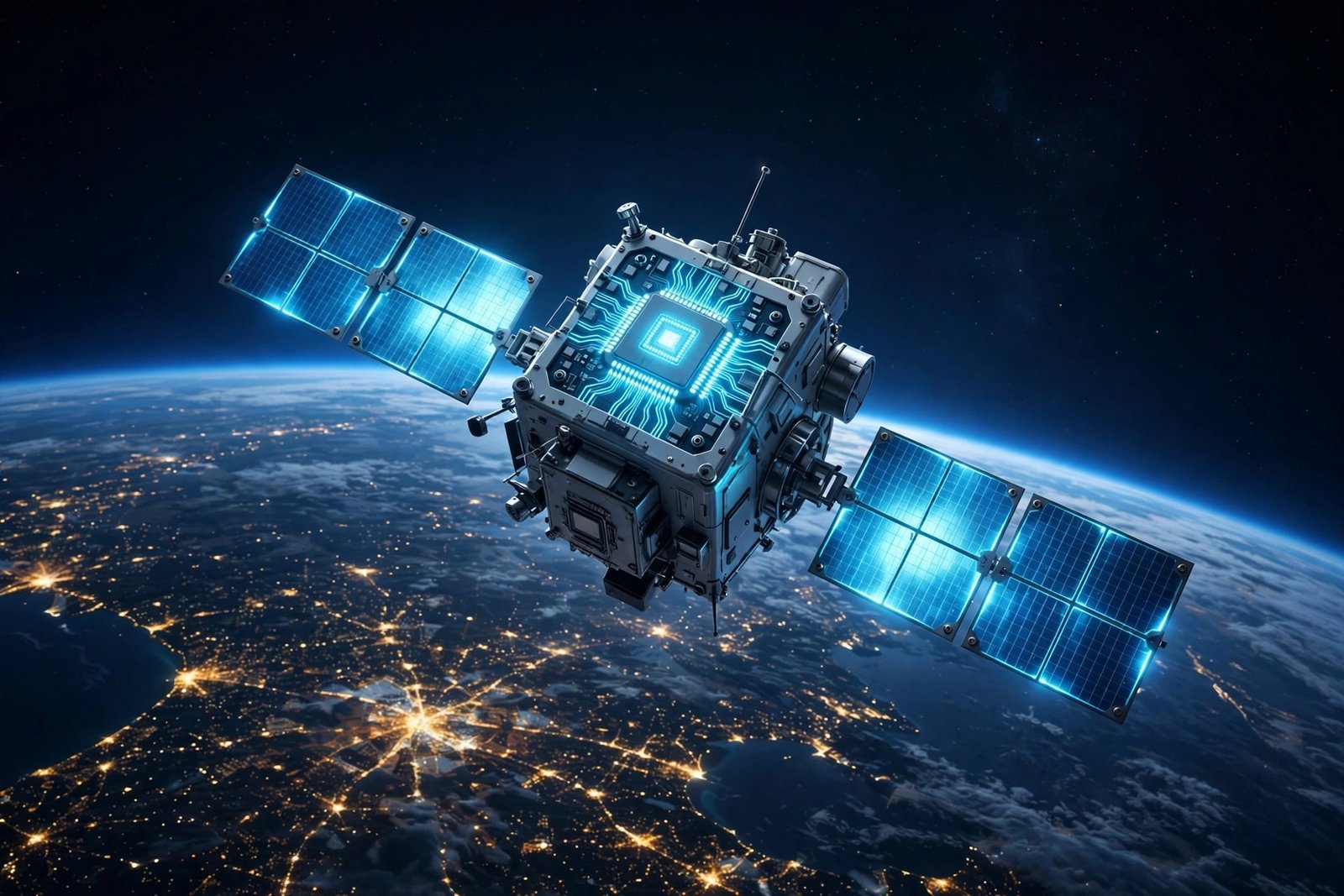
Reports based on Google’s account and outlets such as TechCrunch and NPR describe the satellite as roughly the size of a fridge, carrying four of Google’s Tensor Processing Units, or TPUs. A TPU is the custom AI chip Google designs for its own data centers. It is the same family of hardware that trains and runs many of Google’s AI models on Earth. Putting that kind of chip in orbit is the whole point of the test. Plenty of satellites already carry small processors. Very few carry chips built for the heavy mathematics of modern AI.
There is one detail that the headlines often skip, and it is important. The prototype can run only one TPU at a time, for about 15 to 20 minutes, according to reporting on the test. Its solar panels generate up to about 1 kilowatt of power, roughly what a small household appliance uses at full tilt. That is a tight budget for a chip designed to live in a cooled, power-rich data center hall. So the satellite is not doing continuous AI work. It wakes a chip, runs a short job, and then stops.
After launch, the team spent about three weeks commissioning the satellite. That is the unglamorous phase of any space mission: powering up systems one by one, checking that the host computer and the TPU trays respond, and running early machine-learning checks to confirm nothing was damaged by launch vibration. Only after that did engineers send the first real prompt.
The prompt went up during a pass over a ground station, and the answer came down as the satellite passed over Svalbard, Norway. Google’s senior director for the project, Travis Beals, described the result as the first AI response from a data-center-class TPU in orbit. After the haiku, the team tried space-themed limericks and prompts asking the model to report the technical status of the payload itself. Those follow-up tests matter more than the poem, in my view, because a status report is a practical job. It shows the chip can read telemetry, form a coherent answer, and transmit it. A poem proves the model runs. A status report hints at what the chip might actually do one day.
Why would anyone want a data center in space?
This is the question I kept coming back to while reading about Suncatcher, because on the surface it sounds like a solution looking for a problem. Data centers on Earth already work. They are cheaper to build, easier to repair, and close to the power grid and the fiber cables that carry their traffic. Why move any of that into orbit?
Google’s argument has three parts, and each one deserves a fair hearing.
The first part is energy. A data center on Earth draws enormous amounts of electricity, and much of that electricity still comes from grids that burn fossil fuels. In space, sunlight is abundant and nearly constant if you pick the right orbit. Google’s long-term design imagines satellites in a dawn-dusk sun-synchronous orbit, at an average altitude of about 650 kilometers, where they would sit in near-constant sunlight. The idea is that solar panels up there could power AI chips without drawing on a terrestrial grid at all, and without the water cooling that large data centers on Earth need. Water is a real constraint that rarely makes headlines. A large data center can use millions of liters of water a year for cooling. In orbit, heat is shed through radiators into the cold of space instead.
The second part is the growth of AI demand itself. The numbers here are staggering, and they connect directly to a story I covered on this site at the end of October, when Alphabet lost around $500 billion in market value in a single day as investors questioned whether AI spending would ever pay off. The big technology companies are now planning to spend hundreds of billions of dollars on AI infrastructure in 2026 alone, with estimates for the combined capital spending of Amazon, Alphabet, Microsoft, Meta and SpaceX reaching up to $828 billion for the year, according to Fortune’s tally reported this week. That spending is mostly going into buildings, chips, power contracts and cooling systems on Earth. Google is clearly looking for any approach that could ease the power and land constraints that come with that scale. Space is one of the few places where sunlight and physical room are not the binding constraint.
The third part is latency for space data itself. Satellites already collect vast amounts of imagery and sensor data. Today, much of that data is beamed down to Earth, processed in a ground data center, and then sent back up or distributed to users. If a satellite could process some of that data on board, with a capable AI chip, it could send down a short answer instead of a huge raw file. Think of a satellite spotting a wildfire, a flood, or a damaged road, and reporting the finding in seconds rather than after a full download and ground processing cycle. That is a genuine use case, and it does not require a full data center in orbit. It requires capable chips on satellites that already fly.
Those three arguments are real. They are also, at this stage, mostly theoretical for the full data-center-in-space vision. The prototype flying today proves a chip can run. It does not prove that space computing can compete with ground computing on cost, reliability, or throughput. Keeping those two things separate is the key to understanding this story.
What the test proved, and what it did not
Let me be precise about the milestone, because precision is where most coverage of this story goes wrong.
What it proved: a data-center-class TPU can be powered up in orbit, run a modern open AI model, produce a coherent text answer, and transmit that answer to a ground station. The full loop worked: prompt up, inference on board, answer down. The satellite survived launch, the chip survived commissioning, and the software stack that runs Gemma 4 on Earth ran, in adapted form, in space. For a first test, that is a solid result. Many space experiments fail at the commissioning stage.
What it did not prove: that space data centers are practical, economical, or close. A 15 to 20 minute run on one chip is not a data center workload. A real AI data center runs thousands of chips continuously, for weeks, on jobs that involve enormous data transfers. The prototype has no such throughput. It also has no inter-satellite links yet, which any future constellation would need so satellites can pass work between each other instead of waiting for a ground station pass. Google plans a pair of interconnected satellites in 2027 to test optical links between spacecraft. Until that test flies, the constellation idea remains a drawing.
There is also a correction worth noting, because early coverage blurred it. The test satellite flying today is in a standard orbit and uses batteries, according to an NPR correction reported in follow-up coverage. The near-constant sunlight orbit is the plan for future satellites, not the reality of this one. That does not invalidate the test, but it does mean the solar-power advantage has not yet been demonstrated in its intended form. The satellite generates about 1 kilowatt from its panels, which is a start, not a power station.
The hardest problems are still ahead, and Google has named them openly: thermal stress and radiation exposure. Space is a brutal environment for electronics. Temperatures swing violently between sunlight and shadow. Heat has nowhere to go except through radiators, because there is no air to carry it away. Radiation can flip bits in memory, corrupting data silently, without triggering a normal error alarm. Google researchers published lab work in which they exposed Trillium TPUs to a proton beam while running AI workloads. High-bandwidth memory was the most sensitive part, showing irregularities at a cumulative dose of about 2 krad(Si), roughly three times Google’s own minimum requirement of 750 rad(Si). For typical transformer workloads, the researchers estimated a failure probability on the order of one per three million inferences, which they described as likely acceptable for inference work. That is encouraging, but lab radiation is not orbital radiation over months and years. The coming tests will show whether the chips degrade, how often silent errors occur, and whether error correction can keep up.
In short, Google has passed the first gate. There are several harder gates ahead, and any one of them could slow or reshape the program.
Earth data center versus space data center: an honest comparison
It helps to put the two approaches side by side, because the contrast shows why space computing is a complement at best, not a replacement, for a long time.
| Factor | Data center on Earth | Data center concept in orbit |
|---|---|---|
| Power source | Grid electricity, often mixed sources, plus backup generators | Near-constant sunlight in the planned orbit, via solar panels |
| Cooling | Water and air cooling, large ongoing water use | Radiators shedding heat into space, no water needed |
| Repair | Technicians can walk in and replace a failed part | No repair visit is practical; a failed satellite is usually lost |
| Data transfer | Fiber cables, very high bandwidth, low latency to users | Ground station passes and inter-satellite links, limited windows |
| Cost to build | Land, buildings, power contracts, still very expensive | Launch cost per kilogram plus space-hardened hardware |
| Scale today | Thousands of chips running continuously | One chip at a time, about 15 to 20 minutes per run |
| Best early use | Training and serving large AI models for billions of users | Processing satellite data on board, sending back short answers |

Read that table and the picture almost forms itself. Earth wins on almost every practical measure today: cost, repair, bandwidth, and scale. Space wins on two specific measures: access to sunlight without grid constraints, and proximity to data collected in orbit. That is why I think the most believable near-term future for this technology is not a giant orbital data center serving your chatbot. It is smarter satellites that can filter and summarize what they see before sending anything down.
There is a useful parallel here with a different Google tool I covered recently, Gemini Notebook, which answers questions from your own documents instead of the whole internet. The value of that tool is not that it knows everything. It is that it works on the data closest to the task. On-board satellite AI follows the same logic. Process where the data lives, send back only what matters. That principle scales even if the full space data center never does.
The objections that deserve attention
No honest article about this project should skip the objections, and there are several serious ones.
The first is cost. Launching hardware is expensive, even on rideshare missions, and space-hardened electronics cost far more than their terrestrial equivalents. A satellite that cannot be repaired must be over-engineered and then replaced when it fails. A ground data center, by contrast, can swap a dead server in an afternoon. For space computing to make economic sense, the value of the work done in orbit has to outweigh a large cost premium. Processing satellite imagery on board might clear that bar. Serving general chatbot traffic from orbit almost certainly does not, because ground capacity is cheaper and closer to users.
The second objection is space debris and the night sky. Google’s own illustrative design sketches an 81-satellite constellation, with neighboring satellites roughly 100 to 200 meters apart in its concept. That is a small constellation by the standards of existing broadband networks, which run to thousands of satellites, but every new constellation adds traffic to crowded orbits and adds bright objects to the sky that astronomers must work around. Google has published no brightness estimate for Suncatcher satellites that independent coverage could find. If the program grows, regulators and astronomers will rightly ask for that data. The environmental case for space data centers also cuts both ways: saving water and grid power on Earth is a real benefit, but every launch burns fuel and every dead satellite becomes debris unless it is deorbited cleanly.
The third objection is the simplest: we do not yet have independent verification beyond Google’s own account and the outlets reporting it. No outside team has reproduced the orbital result, and Google’s announcement gives no orbital measurements. That is normal for a first company announcement, and it is not a reason to dismiss the result. It is a reason to treat the next tests, especially the thermal and radiation results, as the real evidence. A company report that inference works in orbit is a claim. A year of operating data is evidence.
The fourth objection is about priorities. At a moment when AI companies are spending hundreds of billions on Earth and investors are asking hard questions about returns, a space research program can look like a distraction. I have some sympathy for that view, but I also think it misunderstands how research budgets work. Suncatcher is a small, focused experiment compared with the data center buildout. Its cost is a rounding error next to a single large data center campus. Judging it as if it were competing for the same budget misses the point. The right question is not whether space computing replaces ground computing. It is whether a small research bet today could open an option that matters in the 2030s, which is the timeframe Google itself points to for this program.
What this means for ordinary readers
If you are a student, a small business owner, a freelancer, or simply someone who uses AI tools every day, here is what this story does and does not mean for you.
It does not mean your AI tools will soon run from space. Your chatbot, your image generator, and your writing assistant will continue to run in ground data centers for the foreseeable future. The physics and economics point that way, and nothing in this test changes that.
It does not mean Google has solved the energy problem of AI. One kilowatt of solar power in orbit is a rounding error next to the gigawatts that AI data centers consume. The energy argument for space computing only becomes interesting at constellation scale, with hundreds or thousands of satellites, and that scale brings its own cost and debris problems.
It does mean something narrower and still interesting. Satellites are getting smarter, and the line between collecting data and understanding data is moving into orbit. Over the next few years, that could mean faster alerts for disasters, fresher maps, better tracking of deforestation or flooding, and quicker damage assessments after storms. Those benefits would reach you through apps and services you already use, not through a satellite you interact with directly. You would notice the result, a faster flood warning or a fresher satellite map, without ever knowing a TPU in orbit helped produce it.
It also means the AI chip race has a new frontier. Google designs its own TPUs, Nvidia dominates the merchant chip market, and AMD and others compete for data center orders. Running a TPU in orbit is partly a technical test and partly a signal: Google intends its chip program to go wherever computing goes next. If space computing grows, Google wants its hardware to be the default choice, just as it wants its models to be. That strategic angle is worth watching, because chip choices made in research programs today often shape commercial products years later. The assistant race is moving just as fast, as I found when comparing Claude Duet, ChatGPT Dots and Meta Muse, and hardware and software advances tend to reinforce each other.
For readers who follow the AI spending story, Suncatcher also adds context to the market anxiety of recent weeks. The same week Google announced a poem from orbit, investors were wiping trillions from technology stocks over doubts about AI returns. Both stories are about the same underlying question: how much should we spend on AI infrastructure, and where? The market story is about money spent on Earth right now. The space story is about a small bet on where computing could go later. They are not contradictory. A company can be disciplined about today’s spending while still funding a long-term experiment. Whether Google strikes that balance well is a judgment investors will keep making, quarter by quarter.
The timeline to watch
If you want to follow this story without getting lost in hype cycles, watch four milestones.
First, the thermal and radiation test results from the current prototype. Google says these are next. Look for specifics: how many errors occurred, whether performance degraded over time, and how long the chips ran continuously. Vague success language without numbers should be treated with caution.
Second, the twin interconnected satellites planned for 2027. Optical links between satellites are the missing piece for any constellation. If two satellites can pass work between each other reliably, the concept moves from a single experiment to a network. If they cannot, the constellation idea stalls.
Third, any cost or power figures Google publishes for a larger system. The current prototype generates about 1 kilowatt. A useful orbital AI system would need far more. Watch for numbers on power per satellite, cost per satellite, and expected lifetime. Without those, the economic case cannot be judged.
Fourth, regulatory and astronomical responses if the program scales. An 81-satellite illustrative constellation is small, but a commercial version would be larger. Brightness data, debris mitigation plans, and deorbit commitments will matter as much as chip performance.
I will keep an eye on the first two milestones in particular, because they are the ones that will tell us whether Suncatcher is a curiosity or a foundation.
My honest take: exciting, but keep it in perspective
I like this story, and I think Google deserves credit for publishing a clear, modest milestone instead of overselling it. Travis Beals and his team called the prototype a very minimal test, and that honesty is refreshing in an industry that often announces a small step as a revolution. The haiku is charming, but the real achievement is unglamorous engineering: a chip built for a cooled hall on Earth booted up in orbit, ran a modern model, and answered.
At the same time, I would not advise anyone to change plans, investments, or expectations because of this test. If you are building a business on AI tools, your decisions still depend on ground data centers, model quality, pricing, and reliability on Earth. If you are a student learning AI, the skills that matter are still programming, data handling, and critical thinking about model outputs, not orbital mechanics. Space computing may matter to your work one day, but that day is not this year, and probably not this decade in any direct sense.
What I would do, if I were following this field, is simple. Bookmark the idea, note the 2027 twin-satellite test, and move on. The most useful technologies often start as small, slightly odd experiments that look unimpressive at first. A poem from orbit is unimpressive as a product. As a proof that a new kind of computing location works at all, it is worth a few minutes of your attention.
And that, in the end, is how I think about Project Suncatcher. Not as the start of data centers in the sky, but as a careful first step toward finding out whether the sky could ever hold them. The haiku was the headline. The engineering behind it is the story. The tests ahead will decide whether the story continues.
Sources and further reading: reporting on the October 30 announcement from TechBooky and Aistify, and Google’s own Project Suncatcher updates as summarized in that coverage. My earlier coverage of Alphabet’s October stock fall gives context on the AI spending debate behind this research.