
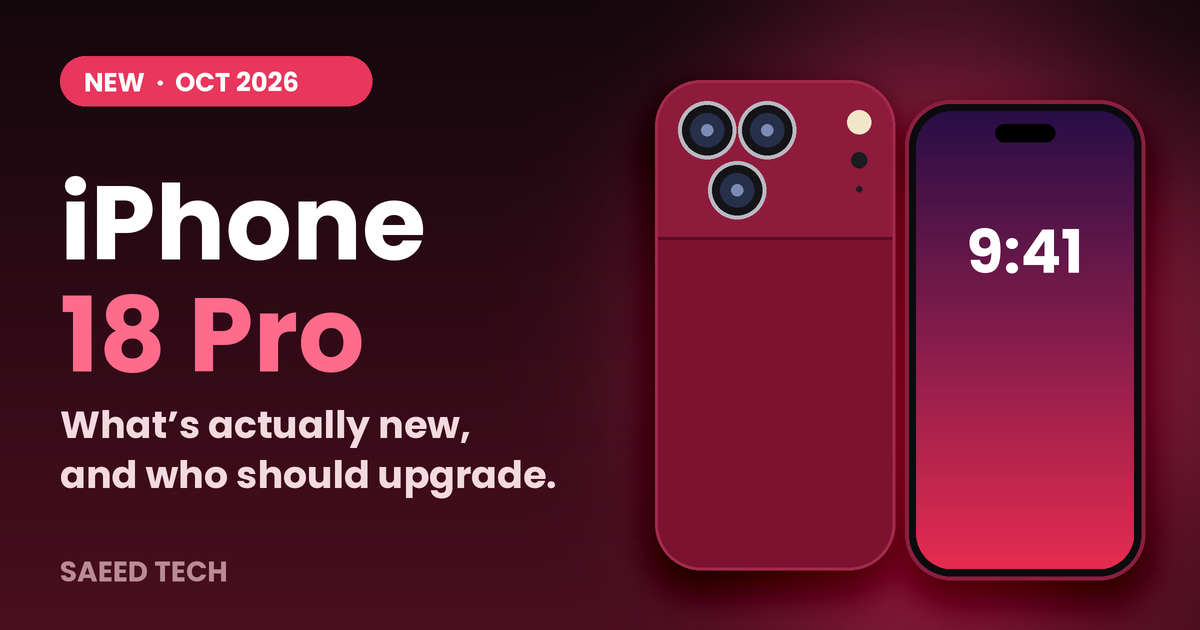
By Saeed Tech | Updated October 19, 2026
Apple announced the iPhone 18 Pro and iPhone 18 Pro Max on September 9, 2026. Pre-orders opened on September 12 and the phones reached stores on September 18. If you’ve been trying to work out whether they’re worth the money, you’ve probably run into a wall of marketing language: “huge leaps,” “most advanced ever,” “incredible battery life.”
So we read Apple’s official launch announcement from start to finish, including the fine print at the bottom, and pulled out what matters. One honest note first: we haven’t tested these phones ourselves, and most of the numbers below are Apple’s own claims. We’ll tell you where that matters.
This article is about the two Pro models. The foldable iPhone Duo is a different phone.
The short version
- Price: The iPhone 18 Pro starts at $1,199 and the Pro Max at $1,299 in the US, both with 256GB of storage.
- Camera: The main camera now has a variable aperture, which Apple says is a first for iPhone.
- Chip: The new A20 Pro is built on a 2-nanometer process, with a redesigned cooling system.
- Battery: Apple rates the Pro at up to 36 hours of video playback and the Pro Max at up to 45, but those figures come with a catch (more on that below).
- Software: iOS 27 brings Siri AI, which launched as a beta with limits you should know about.
Price, storage, and release dates
The iPhone 18 Pro starts at $1,199, or $49.95 a month for 24 months. The iPhone 18 Pro Max starts at $1,299, or $54.12 a month. Storage options are 256GB, 512GB, 1TB, and 2TB, and there are four finishes: black, silver, glacier, and a new burgundy.
Apple says people trading in an iPhone 13 or later can get between $175 and $885 in instant credit in the US. Carrier deals can go as high as $1,200 in credits for an iPhone 14 or later, in any condition. Trade-in values depend on condition, year, and configuration, so treat those as the best case, not a promise.
Pre-orders opened in more than 65 countries and regions on September 12, with availability from September 18. Another 20 countries and regions followed on September 25.
The camera: variable aperture is the headline
The biggest change is the new 48MP Fusion Main camera. Apple says it brings aperture control to iPhone for the first time, using six laser-cut blades that open and close to change how much light reaches the sensor.
What that means in practice, according to Apple:
- In dark scenes, the aperture can open wider, to ƒ/1.48, for better low-light shots.
- For portraits, it uses ƒ/1.8, which Apple describes as the best balance between light and depth of field.
- For group photos, it can narrow to ƒ/4, which keeps more of the background sharp.
The camera adjusts automatically, but there’s also manual control. A new set of Pro controls in the Camera app lets you change aperture, shutter speed, and white balance, and check exposure with a histogram. Apple also says developers get an API, so third-party camera apps can use the aperture range too.
There are a few video and photo extras: Photographic Styles now has texture and grain controls, Cinematic effects can be applied after you shoot (up to 60 fps), time-lapse can record in 4K with Dolby Vision HDR, and Audio Mix can isolate music.
Our take: if you mostly shoot in daylight and post to social media, you might not notice much. If you shoot at night or take lots of group photos, this is the upgrade most likely to show up in your pictures. But “most likely” is still a guess until independent reviewers publish side-by-side comparisons.
Apple Reference Image: a proof-of-photo feature
This one is easy to miss, and it’s more interesting than it sounds. With AI-generated images everywhere, Apple added a way to prove a photo is real. In the new Reference mode, the camera captures signed sensor data, and Apple’s Private Cloud Compute turns it into an unalterable reference image. You can view it in Photos next to the edited version, like a digital negative, to see what changed.
A few limits from Apple’s fine print:
- It’s opt-in, so you have to turn it on.
- It isn’t available in China at launch because of regulatory requirements.
- In the EU, reference image capture isn’t available at launch, though people can still develop and view them.
- Apple says support for the SynthID standard, which helps identify AI-generated or edited images, is coming in a software update later this year.
This matters most for journalists, photographers, and anyone who needs to show a photo hasn’t been tampered with.
Performance: the A20 Pro and a bigger cooling system
Both Pro models use the A20 Pro, Apple’s first chip on a 2-nanometer process. Compared with the A19 Pro, Apple says it has 50 percent more memory bandwidth, a GPU that’s up to 40 percent faster, and double the AI processing power.
The cooling change may matter more in daily use. Apple moved the memory out of the chip’s heat path and attached the chip directly to a new vapor chamber with three times the surface area of the one in the iPhone 17 Pro. Apple says that gives up to a 40 percent gain in sustained performance. In plain English: the phone should slow down less during long gaming sessions or video exports. Again, that’s Apple’s claim, and real-world results will vary.
Connectivity also gets an update. Both models have Apple’s N1 chip for Wi-Fi 7, Bluetooth 6, and Thread. The iPhone 18 Pro introduces C2, Apple’s next-generation cellular modem, which Apple says delivers faster uploads than the previous C1X while using 15 percent less energy. It also adds mmWave support in the US.
Battery: read the fine print
The numbers look great: up to 36 hours of video playback on the Pro and up to 45 hours on the Pro Max. The catch is that Apple says these ratings are for eSIM-only models. The larger battery in those versions uses the space that a physical SIM tray would take, and Apple says it adds two extra hours of video playback.
Apple lists the eSIM-only models as available in Bahrain, Canada, Guam, Japan, Kuwait, Mexico, Oman, Qatar, Saudi Arabia, the UAE, the US, and the US Virgin Islands. If you live somewhere else, you’ll likely get a model with a SIM tray, so check Apple’s spec page for the version sold in your country before you trust the headline numbers.
A few other battery details from Apple:
- The Pro can charge to 50 percent in around 15 minutes with a wire, or in 30 minutes wirelessly.
- On the Pro Max, five minutes of wired charging gives around seven hours of video playback.
- Apple also quotes up to 30 hours of usage on a full charge for the Pro Max, based on a new usage model built on real-world data.
- The fast-charging results were tested with a 60W-capable USB-C cable and a power adapter that Apple lists as sold separately.
Siri AI and iOS 27: exciting, but still a beta
The phones run iOS 27, which arrived on September 14, along with Siri AI. Apple describes it as a new version of Siri that uses personal context, such as your messages, emails, and photos, and can understand what’s on your screen to take action. There’s also a Siri mode in the Camera app, and Apple Intelligence tools like Spatial Reframing, Extend, and an upgraded Clean Up for photos.
Before you pay extra for AI features, here’s what Apple’s footnotes say:
- Siri AI is rolling out as a beta, in English first. French, Japanese, Korean, Portuguese, and Spanish were due in October.
- It isn’t available initially in the EU.
- Some features that rely on server-side models have daily usage limits.
- Apple says expanded access to those features will be available for a fee in the future.
- It isn’t available to users under 13.
That last pair is worth noticing. The AI features are part of the sales pitch, but how much you can use them, and whether some of that use will cost extra later, is still not settled.
Smaller changes worth knowing
The Dynamic Island is smaller. It’s been redesigned and can now show up to three Live Activities at once, while still handling Face ID.
iPhone Handoff. iOS 27 lets people with supported carriers switch between two iPhones that share the same phone number. At launch, that’s T-Mobile in the US and Telekom in Germany.
Cases. This is a messy one. Apple told Daring Fireball’s John Gruber that it isn’t stating 17 Pro and 18 Pro cases are compatible, because the camera plateau on the new phones is slightly thicker. Gruber measured the difference at one-tenth of a millimeter and said his iPhone 17 Pro cases fit the 18 Pro fine. Macworld found that several case makers say their new cases work on both generations, but at least one says its older 17 Pro cases won’t fit the new phones. If you have a favorite case, check with the maker before assuming it will work.
New accessories. Apple added a Wrist Strap ($29) and a Crossbody Strap ($59), plus new Silicone, TechWoven, and FineWoven cases and wallets in matching colors.
Who should upgrade?
This part is our opinion, based on Apple’s announcement and not on testing.
If you have an iPhone 17 Pro: You probably don’t need to rush. The 17 Pro already had the big redesign from last year, and the 18 Pro’s most visible gains are the variable aperture camera, the battery, and sustained performance. If you shoot a lot in low light or you’ve been running out of battery, it’s worth a look. Otherwise, waiting is a fair choice.
If you have an iPhone 14, 15, or 16: The jump is much bigger, especially if your battery is tired or your camera struggles at night. Apple’s trade-in and carrier credits apply to these phones, so compare offers before paying full price.
If you want it mainly for Siri AI: Hold off for a bit. It’s a beta, English-first, with usage limits, and part of the lineup is still unclear in some regions.
If battery life is your top priority: Apple says the Pro Max sees the biggest battery gain in iPhone history. Just remember the eSIM-only fine print before you count on 45 hours.
If you’re thinking about the 2TB model: Ask yourself what you’d actually store. Most people will be fine with less, and storage is the easiest place to save money.
Whatever you decide, wait for independent reviews before spending $1,199 or more. Apple’s battery, charging, and performance numbers come from its own testing.
FAQ
How much does the iPhone 18 Pro cost? In the US, it starts at $1,199 for 256GB. The iPhone 18 Pro Max starts at $1,299.
When was the iPhone 18 Pro released? Apple announced it on September 9, 2026, opened pre-orders on September 12, and made it available on September 18.
What colors does the iPhone 18 Pro come in? Black, silver, glacier, and a new burgundy.
Do both Pro models have the variable aperture camera? Yes. Apple’s announcement covers both the iPhone 18 Pro and the iPhone 18 Pro Max.
What chip does the iPhone 18 Pro use? The A20 Pro, built on a 2-nanometer process.
Is Siri AI available now? It started rolling out as a beta with iOS 27 on September 14, in English first, with more languages due in October. It isn’t initially available in the EU.
Final thoughts
The iPhone 18 Pro is a strong-looking update, and the variable aperture camera and the cooling redesign are real changes, not just spec-sheet decoration. But a lot of the excitement depends on Apple’s own numbers, on a Siri AI that’s still in beta, and on which version of the phone you can actually buy where you live.
If you’re upgrading from an older iPhone, it’s easy to justify. If you already own last year’s Pro, give it a few weeks, read a couple of independent reviews, and see what real owners say.
Sources
- Apple Newsroom, “Apple debuts iPhone 18 Pro and iPhone 18 Pro Max” (September 9, 2026): https://www.apple.com/newsroom/2026/09/apple-debuts-iphone-18-pro-and-iphone-18-pro-max/
- MacRumors, “Are iPhone 17 Pro Cases Compatible With iPhone 18 Pro? Here’s What Apple Says”: https://macrumors.com/2026/09/18/iphone-17-pro-vs-iphone-18-pro-case-compatibility
- Macworld, “iPhone 18 Pro is the same size as the 17 Pro”: https://www.macworld.com/article/3238647/iphone-18-pro-is-the-same-size-as-the-17-pro.html