
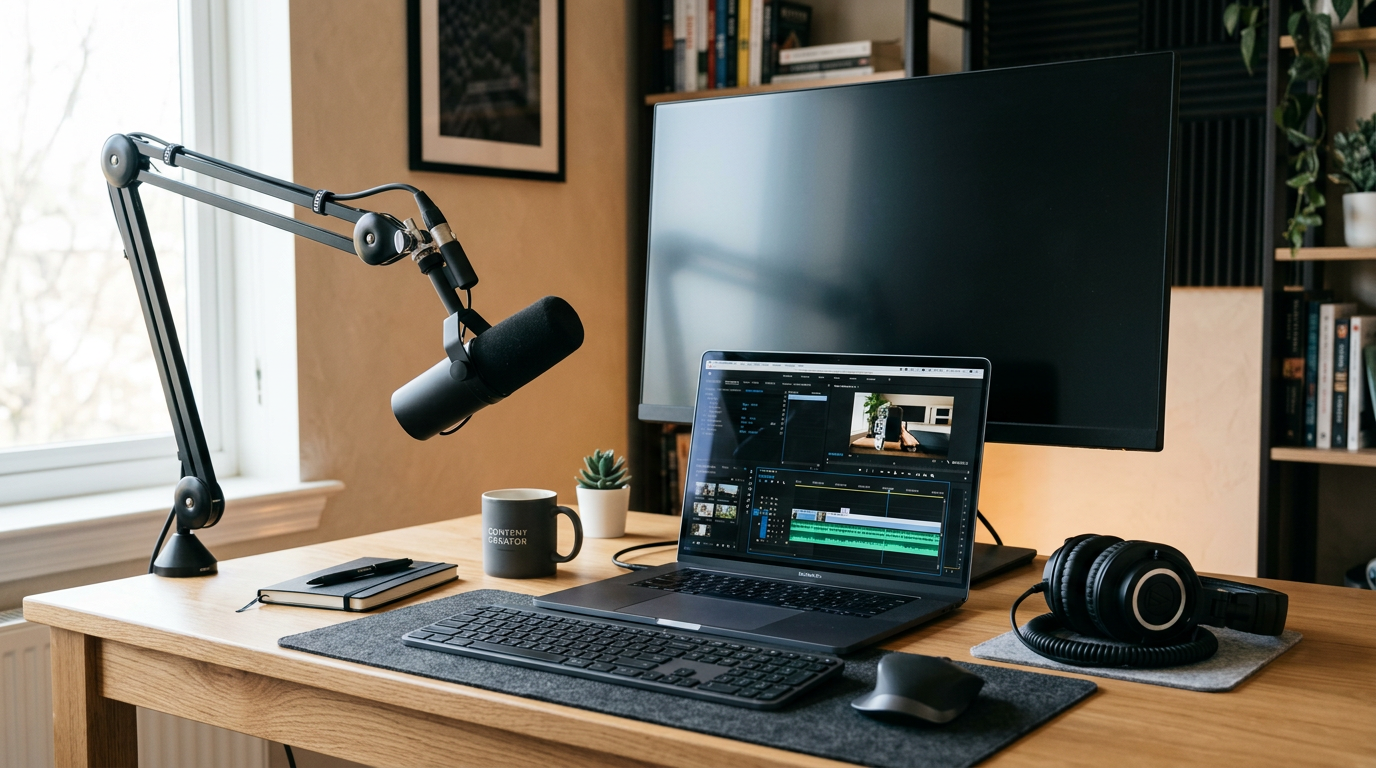
In July 2025, my feed filled with the headline: YouTube is banning faceless channels. Thousands of creators panicked. Some deleted videos. A few deleted channels. The headline was wrong, and the people who acted on it made decisions they did not need to make.
Here is how to start a faceless youtube channel that still works in 2026. A faceless channel is one whose creator never appears on camera: its videos are carried by narration, screen recordings, animation or licensed footage. Yes, such a channel can be monetized. YouTube applies the same Partner Programme thresholds as to any other channel: 1,000 subscribers, plus 4,000 watch hours in a year or 10 million Shorts views in 90 days. The line most beginners cross is not the missing face. It is YouTube’s reused and inauthentic content policies, which bar mass-produced, templated videos from earning money.
YouTube did not ban faceless channels in 2025, and it has not banned them in 2026. What changed was the wording of a monetization policy, and the clarification caught a specific kind of channel, built from templates, repetition and other people’s material. That policy clarification is the most important thing to understand before you upload anything.
This guide is the honest version of the process. It covers the ideas and niches that still work, the small set of tools you genuinely need, the launch steps in order, and the exact rules that get faceless channels rejected. It does not contain an earnings table, because nobody honest can tell you what your channel will earn. What I can tell you is how to build one that YouTube’s reviewers will take seriously.
What Is a Faceless YouTube Channel?
A faceless YouTube channel is simply a channel where the creator never appears on camera. The videos are carried by a voice, a screen, animation, stock footage, or a combination of those elements. The format is old. Some of the largest educational and documentary-style channels on the platform have run for years without the owner ever showing a face.
It helps to separate two groups that get lumped together under the same label. The first group makes original work: researched scripts, their own narration, editing decisions that differ from video to video. The second group mass-produces interchangeable videos from a template, often reading text written by someone else over stock clips, with the topic swapped each time. YouTube’s policies treat these two groups very differently, and almost everything in this guide comes down to staying in the first group.
You do not need a camera, a studio, or a presenter personality. You do need an original contribution in every video. That single requirement shapes your niche choice, your tools and your workflow, so it is worth settling before anything else.
Faceless YouTube Channel Ideas That Can Actually Work in 2026
If you are choosing your first format, pick something you can research and write about every week without hating it by month two. Consistency matters more than a clever concept, and consistency is much easier in a subject you already read about for pleasure.
- “Explained in ten minutes” videos on questions you have genuinely searched for yourself: why a historical event happened, how a technology works, what a common scam looks like from the inside.
- Software walkthroughs for tools you already use: spreadsheets, photo editors, phone settings, free AI tools. Record your screen, narrate the steps, include the mistakes beginners make.
- Local and regional stories told for a global audience: an unusual place, a forgotten event, a tradition with an interesting origin. Your access to the subject is the advantage big channels do not have.
- Book and idea summaries in your own words, where you add your own examples and disagreements rather than reading a summary written elsewhere.
- Data stories: pick a public dataset or a well-documented ranking, and build a narrated video around what the numbers actually show, with your own charts and interpretation.
Notice what is missing from that list: compilations of other people’s clips, readings of articles or Wikipedia pages, and slideshow videos of text over stock footage. Those are not shortcuts. Since the 2025 policy clarification, they are the formats most likely to earn a rejection letter.
The Best Faceless YouTube Niches (and the Ones to Avoid)
The niches that survive are the ones where your input is the product. A viewer should be able to tell that a person researched, wrote and assembled this specific video, rather than a template being fed a new keyword.
Explained topics with original scripts. History, geography, science and “how things work” subjects perform well without a face because the value sits in the research and the explanation. Your script is the original work; the visuals support it.
Software tutorials and screen recordings. Recording your own screen while you talk through a process is inherently original. Nobody else has your exact walkthrough, your mistakes, or your way of explaining a setting. This is also one of the cheapest formats to produce.
Original storytelling. Fiction series, true-crime style narration based on your own research, and documentary-style essays can work well, provided the writing is yours and each episode has a genuinely different story. YouTube explicitly allows series that follow a pattern, as long as each video has a distinct storyline, focus or concept.
List and countdown formats with real commentary. A consistent structure is not a violation. The policy problem starts when the videos feel interchangeable. A countdown where each entry carries your own analysis, examples and opinion is a different product from a countdown assembled from copied summaries.
Two areas deserve a clear warning. First, finance, health, legal and political channels fronted by an AI persona posing as a human expert are specifically barred from monetization under YouTube’s policies; an AI “doctor” or AI financial adviser is not a loophole, it is a named example of what is not allowed. Second, pure relaxation loops and ambient compilations sit close to the templated-content line, because one upload is barely distinguishable from the next. Neither is a sensible foundation for a new channel in 2026.
How to Create a Faceless YouTube Channel, Step by Step
The five steps below are the whole launch process, in the order I would follow it. They assume the small toolkit covered in the tools section that follows; if you have not yet chosen a microphone or an editor, read that section first and then come back here.
Step 1: Choose Your Format and Plan the First Ten Videos
Pick one niche and one repeatable format, then write down ten video topics before you create the channel. This sounds like homework, but it solves the two problems that kill new channels: running out of ideas by week three, and drifting between formats so the audience never knows what the channel is.
Your ten topics should be variations with genuinely different substance, not the same video with a new keyword. If each topic needs its own research and its own script, the list is good. If you could produce all ten by changing one word in a template, the list is exactly what YouTube’s reviewers are trained to reject.
Step 2: Set Up the Channel Properly
Create the channel under a Google account you control, and turn on 2-Step Verification for that account, because YouTube requires it later for the Partner Programme. Choose a channel name you can still live with in two years; avoid names built around a single trend or a single tool. Upload a simple logo and banner, and write the About section carefully. This is not decoration. When YouTube reviews a channel for monetization, its reviewers look at the channel’s main theme, its most viewed and newest videos, its metadata, and the About section. A clear About page that states who makes the videos and what they cover is a small but real signal that a person runs the channel.
Step 3: Produce Your First Faceless Video
Work in this order: script, voice, visuals, edit. Write the script in full sentences, in your own words, from research you actually did. Read it aloud once before recording; sentences that look fine on paper often collapse when spoken, and rewriting at this stage is free.
Record the narration in the quietest conditions you can manage, then assemble the visuals against it. Match what is on screen to what is being said at that moment, change the visual often enough to hold attention, and resist the slideshow pattern of static images drifting under unrelated narration. Finish with a title and thumbnail before you upload, not after: decide what the video promises, then make the thumbnail prove that promise in one image and three or four words.
Step 4: Titles, Thumbnails and the Upload Settings That Matter
Write titles a person would click and a search engine can understand: the subject in plain words, one specific detail, no all-caps shouting. Your thumbnail and title should work as a pair, each adding information the other does not carry.
During upload, YouTube Studio asks an “AI use” question about altered or synthetic content. Answer it honestly. Disclosure is required when AI generates or meaningfully alters realistic content: a real person made to appear to say or do something they did not, footage of a real event or place that has been altered, or a realistic scene that never happened. Answering yes does not reduce your audience or your monetization eligibility; YouTube states that directly in its help pages. Answering no when the answer should have been yes is the risky option, because YouTube can apply the label itself and penalize channels that consistently fail to disclose, up to removal of content or suspension from the Partner Programme.
Step 5: Publish Consistently and Read Your Analytics
Set a schedule you can hold on your worst week, not your best one. For a researched faceless format, one good video a week is a sustainable starting point for most people holding a job or studying. Protect the schedule by keeping two finished videos in reserve before you publish the first one.
After ten uploads, read the analytics without emotion. Audience retention shows you the exact second viewers leave, and that graph teaches faster than any advice, including mine. If viewers leave in the first thirty seconds, your openings are slow. If they leave at the same segment in every video, that segment type is the problem. Adjust the next videos, not the ones already published, and give the channel a fair trial of several months before judging it.
Faceless YouTube Automation: Tools for Scripts, Voiceovers and Editing
“Automation” is the word this niche uses for its tool stack, and the tools themselves are not the problem or the shortcut they are sold as. They save time on production tasks. They do not supply the original contribution YouTube requires, and a channel that forgets that distinction becomes the policy example discussed below.

A microphone before anything else. Your voice carries the channel, so audio comes first. A serviceable USB microphone costs roughly $30 to $70 and will outperform any phone recording in a quiet room. If the budget is zero, record on your phone in the quietest room you have, ideally with soft furnishings around you, and clean the result in a free editor such as Audacity. Viewers forgive plain visuals far more readily than echoing, distant audio.
A voice decision. Recording your own voice is free, fully original, and the safest long-term choice. AI text-to-speech has improved a great deal, and services such as ElevenLabs offer free tiers for testing, so it is a legitimate option if you cannot record (a shared home, a speech issue, working at night). Two honest cautions: a synthetic voice makes it even more important that the script is visibly your own work, and some audiences simply prefer a human voice and say so in the comments. Treat AI voice as a production tool, not as the channel’s personality.
Editing software. You do not need a professional suite to start. CapCut and VN both handle faceless formats well on a phone or computer, and I compared them in detail in my CapCut vs VN comparison if you want help choosing between the two. What matters is not the brand of the editor. It is whether you can cut cleanly, place visuals that match the narration, and vary the pacing from video to video.
Visual material with proper licences. Free stock libraries such as Pexels and Pixabay cover a large share of what a beginner needs, and screen recording with a free tool like OBS covers the rest. If you shoot your own photos or footage, the same stock agencies are also a place to license your own work for income; I covered that side of the business in my guide to selling stock photos online. For thumbnails, Canva’s free tier is enough to start, and cutting a subject cleanly out of a photo is the one skill worth learning early; I covered the free methods in my guide to removing an image background for free.
AI help, used in the right place. Drafting outlines, checking a script for clarity, and generating a background visual are reasonable uses of AI tools, and my guide to AI tools that save freelancers time covers several that transfer directly to this work. The line to respect is simple: AI can help you produce the video, but the research, structure and opinions have to be yours. That is not only an ethical point. As the next section shows, it is now written into YouTube’s monetization rules.
How Faceless Channels Make Money — and YouTube’s Monetization Rules
The money side of a faceless channel is deliberately unglamorous: once a channel is inside the Partner Programme, it earns a share of the advertising revenue its videos generate, at rates that vary widely by niche, audience country and season. Any guide that presents a fixed earnings figure per thousand views as a planning number is selling you something. What you can plan around is the rulebook, because the rulebook decides whether you are allowed to earn at all.
The July 2025 Policy Change: “Inauthentic Content”
On July 15, 2025, YouTube updated its channel monetization policies with a note that reads, in its own words: “We’re making a minor update to our ‘repetitious content’ policy to better clarify this includes content that is repetitive or mass-produced. We are also renaming this policy from ‘repetitious content’ to ‘inauthentic content.'” The same note states that this type of content “has always been ineligible for monetization.” It was a clarificatchange.
In practical terms, the current policy page says monetized content must be original and authentic, and must not be “mass-produced, generic, repetitive, or manipulative.” It names the pattern directly: content that looks like it was made with a template, where the videos feel interchangeable from one upload to the next. The examples of what cannot be monetized include image slideshows and scrolling text with minimal narrative or commentary, storylines repeated with the same outcome, and “AI-generated content made with generic or unoriginal templates giving the impression of mass production without adding the creator’s original, authentic insights or perspective.”
Read that last example carefully, because it defines the modern faceless risk. The problem is not the AI tool, and it is not the absence of a face. The problem is mass production without original input. The same policy page lists what is allowed: a series following a pattern where each video has a distinct storyline, focus or concept; a consistent intro and outro when the bulk of each video is different; and using AI to visualize a unique character and narrative that you invented. A faceless channel built on your own scripts, your own research and visibly different videos sits inside the allowed examples.
The neighbouring rule is the reused content policy, and it matters just as much. Repurposing content from YouTube or elsewhere without significant original commentary, substantive modification, or added educational or entertainment value is not monetizable, and this applies even if you have the original creator’s permission, because the policy is separate from copyright. Reading another site’s article aloud over stock footage, compiling other people’s clips, or uploading content that many other channels have already uploaded are all named violations. Faceless does not mean anonymous to the reviewers: they assess the channel as a whole, including your most viewed videos and the largest share of your watch time.
The Partner Programme Thresholds and the Review
Nothing about the Partner Programme is different for a faceless channel. The thresholds, the review and the rules are identical for everyone, and YouTube publishes them on its Partner Programme overview page.
To apply for ad revenue, a channel needs 1,000 subscribers plus one of the following: 4,000 qualified public watch hours in the last 12 months, or 10 million qualified Shorts views in the last 90 days. Watch hours earned from Shorts playing in the Shorts feed do not count toward the 4,000 hours, which is why most faceless channels aim at long-form video or treat Shorts as a discovery tool rather than the main path. You also need to live in a country where the programme is available, have no active Community Guidelines strikes, have 2-Step Verification turned on, have advanced features access, and link one active AdSense for YouTube account.

Meeting the numbers does not end the process. You apply in YouTube Studio under the Earn section, accept the programme terms, and link the AdSense account, after which your channel enters a review queue. YouTube says its automated systems and human reviewers examine the channel as a whole, and that a decision typically takes about a month. If the application is refused, you can appeal within 21 days, or keep uploading original content and apply again after 30 days (90 days if a channel has been refused more than once). This is the moment the earlier sections are really about: the review is where template channels fail, and where a channel with ten visibly original videos has its best day.
Two smaller points complete the picture. There is an expanded tier of the programme in many countries that gives earlier access to fan funding and Shopping features at lower thresholds, which can be worth taking if it is offered to you, but ad revenue waits for the full thresholds above. And once you are in, stay active: YouTube states it may turn off monetization on channels that have not uploaded a video or posted to the Posts tab for six months or more.
Faceless YouTube Shorts: Worth Doing?
Shorts are the one part of this format where the honest answer is “it depends,” because Shorts do two different jobs and only one of them is reliable.
The reliable job is discovery. A Short is cheap to test, travels further per upload than an early long-form video usually does, and can put your channel’s subject in front of people who would never have clicked a ten-minute video from an unknown name. Used that way, as a trailer for the channel rather than the channel itself, Shorts earn their keep. They are also the raw material of the second monetization path: 10 million qualified Shorts views in 90 days substitutes for the 4,000 watch hours, though for a small channel that number is, in practice, the harder of the two targets.
The cautions are real. Watch time from Shorts playing in the Shorts feed does not count toward the 4,000 long-form hours, so a Shorts-heavy channel can look busy while making no progress on the main threshold. Subscribers gained from Shorts also convert poorly to long-form viewers; many subscribed for thirty-second videos and will never watch a ten-minute one, which can depress the early analytics of the videos you actually care about. And the inauthentic content policy applies to Shorts exactly as it does to long-form: a stream of templated, near-identical Shorts is still mass production, just shorter.
My working rule: make Shorts from your long-form research, one idea per Short, each with its own script and its own point. If a Short would embarrass you as a standalone piece of work, it is not a funnel; it is filler with your channel’s name on it.
Mistakes That Get Faceless Channels Rejected or Demonetized
Reading other people’s text as your script. The policy page names this almost word for word: content that exclusively features readings of material you did not create, such as text from websites or news feeds, is not allowed. A text-to-speech voice reading Wikipedia is the single most common faceless setup online, and it fails on two policies at once.
Buying a shortcut. Pre-made channel packages, copied templates and “automation” kits sold with income screenshots produce exactly the interchangeable output the inauthentic content policy describes. They also tend to come with reused material baked in.
Treating every video as the same video. Same structure is fine; same substance is not. If a reviewer watches three of your uploads and cannot tell them apart beyond the title, that is the finding you will read in your rejection email.
Skipping disclosure for realistic AI content. A photorealistic AI scene or an altered real event needs the AI use declaration at upload. The declaration costs nothing. The penalty for repeatedly avoiding it can cost the channel.
Chasing an earnings table instead of an audience. The channels that survive review share a boring trait: they made videos a specific audience wanted, for months, before money entered the discussion. Channels built backwards from an advertised revenue figure tend to cut precisely the corners (original writing, real research, varied production) that the policies protect.
Quitting at video six. This is not a policy mistake, but it ends more faceless channels than any rejection. Ten to twenty uploads is a reasonable minimum before the format has had a fair test, and most channels look unremarkable at that stage, including many that later did well.
Frequently Asked Questions
Can a faceless YouTube channel be monetized?
Yes. There is no rule against faceless channels, and no separate or harder standard for them. The Partner Programme thresholds and the channel review are the same as for any other channel. What gets rejected is not the missing face; it is templated, repetitive or reused content, which happens to be common in this format.
How much does it cost to start a faceless YouTube channel?
It can start at zero. A phone for recording, free editing software such as CapCut or VN, free stock libraries and free AI tiers cover a basic production setup. The first purchase worth making is a USB microphone in the $30 to $70 range, once you know you will continue. Paid voices, premium stock and faster tools are conveniences added later, not entry requirements, and none of them changes your standing in the Partner Programme review.
Is faceless YouTube automation allowed?
The tools are allowed; the output pattern is what gets judged. Using software to draft, narrate, edit or schedule is ordinary production, and YouTube’s own allowed examples include using creative tools to assist a unique narrative. What is not allowed is automation as a substitute for authorship: mass-produced videos from generic templates, published at volume with no original insight. If a person reviewing your channel cannot tell what you personally contributed, the tool stack will not save it.
How long does it take to get monetized?
There is no standard timeline, and anyone who gives you one is guessing. For a researched long-form format publishing weekly, several months of consistent uploads is a realistic planning horizon, and a year or more is not unusual. Some channels grow much faster on one strong video; many grow slowly and steadily. Plan your effort around a six-to-twelve-month test, because a channel abandoned at week six has not really been tested at all.
Do I have to disclose AI-generated content?
It depends on what the AI produced. YouTube requires disclosure at upload when AI generates or meaningfully alters realistic content: a real person appearing to say or do something they did not, altered footage of a real event or place, or a realistic scene that never occurred. Using AI to help draft a script, generate captions, or produce clearly unrealistic visuals does not require the label. Disclosing when required does not limit your audience or your monetization eligibility; YouTube says so in its own help pages.
Would I Start a Faceless Channel Today?
Yes, with conditions, and I say that as someone who publishes video under the Saeed Tech name already. The format itself is not the risk it was rumoured to be in 2025. The risk is a specific way of working: fast, templated, and borrowed. Avoid that way of working and the format is simply a production choice, like choosing to write articles instead of recording podcasts.
If I were starting from zero, I would do three things. First, choose a subject I already know well enough to research quickly, because the script is the product and weak research shows within a minute. Second, write the first ten scripts before uploading anything, so the channel launches with a reserve instead of a weekly panic. Third, use my own voice if at all possible; it is free, it is unmistakably mine, and it removes one whole category of sameness that reviewers and viewers both notice.
Who should skip it: anyone who needs the income soon, anyone whose plan depends on publishing other people’s material in a new wrapper, and anyone who dislikes writing. A faceless channel is a writing job with a video attached. If that sentence sounds appealing rather than disappointing, this format may suit you better than being on camera ever would.